Last updated: October 2026
Your underwear spends almost all day against the most sensitive skin on your body, with heat, sweat and friction. Yet almost nobody checks what it's made of. We reviewed 10 of the most searched underwear brands in the US against the same four criteria, using only public information anyone can check.
What Makes Underwear "Toxic"?
"Toxic" isn't a technical term, and no ordinary pair of underwear is going to poison you. What does exist are substances and materials that have no reason to be in contact with your intimate area. These are the four worth watching.
PFAS, the "forever chemicals"
PFAS are compounds used to repel water and stains, and they take an extremely long time to break down. In 2022, a class action lawsuit accused Thinx of selling period underwear that contained PFAS. The company denied it and admitted no wrongdoing, but in 2023 it agreed to a $4 million settlement. It committed to not intentionally adding PFAS and to disclosing its antimicrobial treatments. In regular underwear, with no absorbent or stain-resistant function, there's no reason for them to be there.
Dyes
Textile dyes are a known cause of contact dermatitis. According to DermNet, disperse dyes such as Disperse Blue 106 and 124 are common causes. The waistband area, upper thighs and buttocks are commonly involved, where there's friction and sweat, and sweat can release dye from the fabric. Their advice for people who react: light-colored clothing, natural fibers such as cotton, and washing new clothes at least three times before wearing them.

Synthetic fibers and added treatments
Nylon and polyester breathe less than cotton and trap more heat and moisture. Some brands also add anti-odor or antimicrobial treatments, with zinc or silver. They aren't necessarily harmful, but they're one more substance on your skin, and it's worth knowing they're there.
Bamboo isn't what it seems
Most bamboo underwear is actually viscose: the bamboo cellulose is dissolved with carbon disulfide and caustic soda to turn it into fiber. That's why, even when the bamboo is grown organically, the final garment can't be sold as organic. Lyocell is a cleaner process, because it recovers almost all of its solvents.
How We Reviewed Each Brand
We applied the same four criteria to every brand:
- Material: what the garment is made of, and above all the gusset (the part in direct contact with you).
- Certifications: whether it has GOTS, OEKO-TEX Standard 100 or another verifiable certification.
- Chemicals and treatments: whether the brand discloses PFAS, antimicrobial treatments or dye information.
- Transparency: whether the information is on the product page or you have to go looking for it.
We didn't lab-test any garments. This article summarizes what each brand and its retailers publish, with sources linked at the end.
The 10 Brands, One by One
Based on publicly available product information as of October 29, 2026. Brands may change their products.
Ordered by how many people search whether they're non-toxic. Each summary lists published composition and certifications only; it isn't a health assessment.
Huha
Its thong is 90% TENCEL™ Modal and 10% spandex, with a lining of TENCEL™ lyocell blended with zinc oxide, which the brand describes as antimicrobial. We didn't find a named certification on the product page.
Bamboo Cool
Its product pages give 92% bamboo viscose and 8% spandex (one pack lists 89% viscose made from bamboo, 8% spandex and 3% polyester). The only certification mentioned is FSC (brand claim); no OEKO-TEX or organic certification is listed.
Pact
Pact uses GOTS-certified organic cotton, which Sustainable Jungle has checked against the certifier's public registry. Just over half of its styles are made only of organic cotton or linen, and the rest add between 2% and 10% elastane. The brand describes its clothes as free of toxic dyes, harsh chemicals and PFAS.
Boody
Its Classic Bikini is 79% viscose made from bamboo, 15% nylon and 6% elastane. The product page doesn't mention a certification.
Bombas
Its underwear combines cotton, modal and spandex in varying percentages, with mesh zones for ventilation. We didn't find any published certifications.
Tommy John
Its Cool Cotton line is 86% pima cotton and 14% spandex. Second Skin is 90% micro modal and 10% spandex, and Air is 77% nylon mesh and 23% spandex. None of these lines is presented as organic.
Skims
Its Everyday Cotton Thong is 90% cotton and 10% elastane, with a 100% cotton gusset. The product page makes no organic claim and lists no certifications.
Calvin Klein
Its Modern Cotton thong is 53% cotton, 35% modal and 12% elastane. No mention of organic cotton or certifications.
Quince
Its organic cotton thong is "made with OCS-certified organic cotton", with no fiber percentages listed. Note: OCS certifies that the fiber is organic, but unlike GOTS, it doesn't cover the chemicals used in dyeing and finishing. The product page gives no dye information.
Aerie
Its cotton underwear section doesn't list compositions or mention organic cotton or certifications.
Quick Comparison
| Brand | Main material | Certification found | Treatments or dyes disclosed |
|---|---|---|---|
| Pact | Organic cotton | GOTS (verified) | Says it uses no toxic dyes or PFAS |
| Quince | Organic cotton | OCS | Not disclosed |
| Boody | Bamboo viscose, nylon and elastane | None on product page | Not disclosed |
| Tommy John (Cool Cotton) | Conventional pima cotton | None published | Not disclosed |
| Calvin Klein (Modern Cotton) | Cotton, modal and elastane | None published | Not disclosed |
| Bombas | Cotton, modal and elastane | None published | Not disclosed |
| Skims (Everyday Cotton Thong) | Cotton and elastane (90/10) | None published | Not disclosed |
| Aerie | Cotton (composition not detailed) | None published | Not disclosed |
| Huha | TENCEL™ Modal and lyocell | None found | Zinc oxide in the lining |
| Bamboo Cool | Bamboo viscose | FSC (brand claim) | Not disclosed |
How to Choose Non-Toxic Underwear
Five things you can check on any label or product page:
- A 100% cotton gusset. It's the part that touches your intimate area; if it's synthetic, skip it.
- A verifiable certification. GOTS is the most complete: it covers the organic fiber and the chemicals used in processing. OEKO-TEX Standard 100 limits residues in the finished garment. Both have public certificate databases.
- Watch out for "antimicrobial", "odor-control" or "stain-resistant" with no explanation: they're added treatments.
- Bamboo almost always means viscose. If you want a cellulose fiber, lyocell is the better choice.
- Light or undyed colors if you have sensitive skin, and wash any new garment before wearing it.
Where Egos In Check Fits In
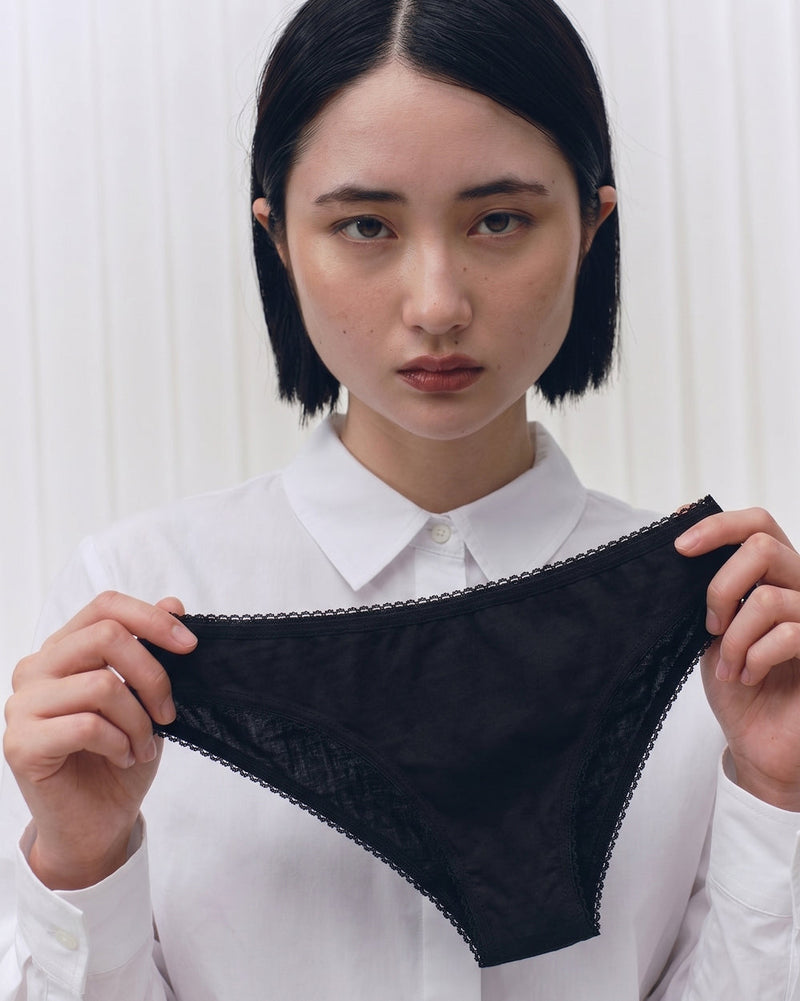
We started Egos In Check because we wanted underwear we could check against this list ourselves. We make thongs and bikinis in organic Pima cotton, sewn in Peru, in two colors: Onyx Black and Undyed, a soft beige that is simply the natural color of cotton, with no dye at all. Every batch goes through a quality audit before leaving the workshop in Peru. The edges are finished with a small picot trim that makes it more elegant without giving up comfort.
Here's where we stand on the first two criteria:
- Material: the fabric, gusset included, is organic Pima cotton, a long-staple fiber that's softer and more durable than conventional cotton. The exact composition of each piece, elastic included, will be listed on its label and product page.
- Certifications: our cotton is organic, but the finished garment isn't independently certified yet. We'd rather say so plainly than use a seal that isn't ours yet.
Want to go deeper on fabrics? Read Pima vs Egyptian vs Supima vs Regular Cotton and Bamboo vs Cotton Underwear.
Frequently Asked Questions
Is cotton underwear non-toxic?
Cotton is the best base, but it isn't enough on its own: conventional cotton can carry chemical dyes and finishes. Look for organic cotton with GOTS or OEKO-TEX certification.
Is bamboo underwear non-toxic?
It's usually viscose, made with chemical solvents. An OEKO-TEX certification guarantees residue limits in the garment, but the process is still chemical.
What is the healthiest fabric for underwear?
For everyday wear, breathable cotton, ideally organic and undyed, especially in the gusset.
Should you wash new underwear before wearing it?
Yes. DermNet recommends washing new clothes at least three times if you tend to react, to remove dye that hasn't fully set.
Sources
All sources accessed October 29, 2026.
- Thinx period underwear lawsuit over PFAS settles for $4 million (FOX 29)
- Textile dye allergy (DermNet)
- Huha Iron Thong, product page (Huha)
- Bamboo Cool women's high-waisted briefs, 5-pack (Bamboo Cool)
- Bamboo Cool women's breathable mesh briefs, 6-pack (Bamboo Cool)
- Pact brand rating (Sustainable Jungle)
- Boody Classic Bikini, product page (Boody)
- Bombas underwear review (Greenlit Content)
- Women's underwear collections (Tommy John help center)
- Everyday Cotton Thong, product page (Skims)
- Calvin Klein Modern Cotton thong, product page (Altitude Sports)
- Quince organic cotton high cut thong (Quince)
- Aerie cotton underwear (American Eagle)